🧠 Project Overview
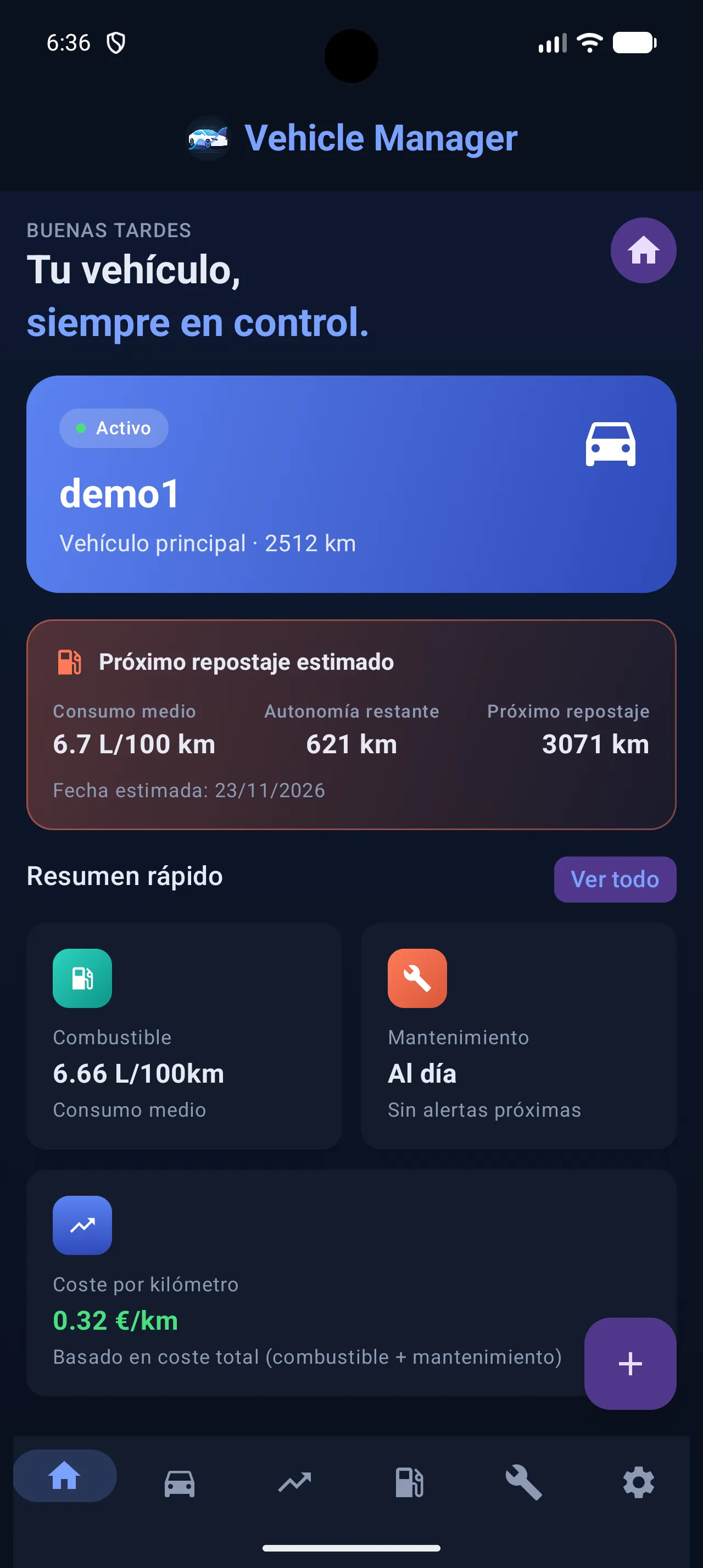
Goal: answer the questions a vehicle actually gets asked — how much have I spent on fuel, what is every kilometer costing me, when is the next service due, how does my consumption look this month? — from the phone, with no account, no connection, and without anybody else seeing the data.
It started as a tool for personal use: the name (“Vehicle Manager”) is deliberately generic because it was built to solve my own refuel and workshop log. When a couple of friends liked the idea, I decided to publish it: an APK downloadable from its own landing page, a repository on GitHub under the MIT license, and a public changelog.
Current features:
- Vehicles: create and edit brand, license plate and odometer, with a list of registered vehicles.
- Fuel: record refuels with odometer, price per liter, liters and auto-calculated total cost; the new odometer propagates to every view of the vehicle.
- Maintenance: per-vehicle service history with cost and odometer reading, merged with refuels into a single chronological timeline.
- Dashboard and statistics: monthly, quarterly, semi-annual and annual summaries, cost per kilometer, monthly breakdown, a consumption prediction engine and a next-refuel estimator.
- Reminders: alerts ahead by kilometers or days (refuel, tire pressure, services) with time and vibration preferences.
- Settings: light / dark / automatic theme, JSON backup export and import, and a visible state for notification permissions.
🏗️ Architecture: Clean Architecture across two packages
The app follows a Clean Architecture with layered separation, in
com.example.vehiclemanager split into core/ (everything
cross-cutting) and feature/ (one folder per screen with its own
logic).
graph TD
  UI[Jetpack Compose screens] --> VM[ViewModels<br/>UI state]
  VM --> UC["core/domain<br/>models + use cases"]
  UC --> REPO[Repository interfaces]
  REPO --> DATA["core/data<br/>implementations"]
  DATA --> ROOM[(Room / SQLite<br/>versioned schemas)]
  DATA --> DS[(DataStore<br/>preferences)]
  DATA -.schedules.-> WM[WorkManager<br/>periodic work]
  WM --> NOTIF[Notifications<br/>km / days ahead]
  DATA <-->|JSON| BK[Backup export / import<br/>kotlinx-serialization]
  UI --- FEAT["feature/ vehicles · fuel ·<br/>maintenance · dashboard ·<br/>statistics · settings"]
Each layer lives on its own:
- UI — Compose screens with ViewModels exposing UI state; no data access straight from composables.
- Domain (
core/domain/) — models, repository interfaces and use cases. The only layer the features know about. - Data (
core/data/) — Room entities and DAOs, theVehicleDatabaseclass, DataStore preferences and the repository implementations.
🧰 Technologies Used
- Kotlin as the only language, with Jetpack Compose and Material 3 for declarative UI.
- Clean Architecture in
core/(domain / data / ui) +feature/(vehicles, fuel, maintenance, settings, dashboard, statistics). - Room (local SQLite) as the database, DataStore for preferences and Hilt for dependency injection.
- WorkManager for reminders that must survive a device reboot, Coroutines & Flow as the concurrency model and kotlinx-serialization for the JSON backup.
- Tests with JUnit and Robolectric over the DAOs on the JVM, plus instrumented tests on device.
- Gradle Kotlin DSL with a version catalog
(
gradle/libs.versions.toml) and a public CHANGELOG.md under SemVer.
🌐 Landing (vehicle-manager-landing)
- Download site with the value proposition, four features, a
privacy section, screenshots (
/screens/*.webp), an FAQ and the APK download block. - Deployed on Vercel at https://vehicle-manager-landing.vercel.app/, linking the APK (≈ 4 MB) directly and the app repository as “View on GitHub”.
📦 Infrastructure and Deployment
- Direct distribution: release APK downloadable from the landing page — no Play Store for now, with “coming soon to Google Play” announced on the page itself.
- Requirements stated to users: Android 8.0 (API 26) or newer, ≈ 4 MB install, current version 0.3.0.
- Landing on Vercel: a static site that centralizes the pitch, the privacy proof points, the screenshots and the download/repository links.
- Transparency: public changelog at the root of the repository and the MIT license on the code.
- No backend: no server, no cloud database, no API keys and no third-party services to monitor — the app’s “deploy” is a single APK file.
🌐 User Navigation and Flows
graph LR
  SPLASH[Splash + adaptive icon] --> DASH[Dashboard<br/>vehicle summary]
  DASH -->|3 taps| FUEL[New refuel]
  DASH -->|+| SVC[New service]
  DASH --> STATS[Statistics<br/>cost/km and projections]
  DASH --> SET[Settings<br/>theme · reminders · backup]
  FUEL --> TL[Timeline<br/>refuels + services]
  SVC --> TL
  TL --> NEXT[Next-refuel<br/>estimator]
  SET --> BK[Export / import<br/>JSON backup]
🧭 Recording flow: open the app → pick the vehicle → fill in odometer, liters and price → total cost and L/100km calculate themselves → save → the new odometer updates dashboard, statistics and timeline in one go.
🔐 Key Technical Decisions
✅ 1. Privacy by design: zero accounts, zero servers
The obvious alternative was a backend with login syncing vehicles across devices. I dropped it: a person’s fuel and expense data is sensitive, and 90% of the use happens on a single phone. With local Room/SQLite, no signup and no telemetry, the app behaves identically on a plane and on wifi, and “what happens to your data?” gets a one-line answer: it never leaves your phone.
✅ 2. core/ + feature/ instead of a package per layer
Global layer packages (ui/, domain/, data/ at the root)
mean adding a screen touches three different folders and features
leak into each other. The hybrid package keeps each capability
encapsulated — the fuel/ module does not know statistics/
exists — leaving only what is genuinely cross-cutting in core/.
✅ 3. WorkManager for reminders, not hand-rolled alarms
The first version scheduled alarms straight with AlarmManager,
and they were lost whenever the phone rebooted. Reminders (km or
days ahead) are reschedulable periodic work: WorkManager with
hilt-work survives reboots, reschedules automatically, and
surfaces the notification-permission state in Settings instead of
failing silently.
✅ 4. Versioned, exported Room schemas
app/schemas holds the JSON of every schema version (five so
far), which turns each migration into a reviewable, testable
artifact under room-testing rather than a “trust me” that blows
up on users updating from the Play Store.
✅ 5. Portable JSON backup as the only way to move data
With no cloud and no account, an exportable/importable backup is
the only migration path between phones. A plain JSON file
(kotlinx-serialization) over a proprietary binary format keeps
the file readable, versionable and recoverable even if the app
disappears tomorrow.
📈 Current Outcome
✔️ Version 0.3.0 released (2026-03-07) with a SemVer changelog: notification permissions surfaced in Settings, explicit save for preferences, corrected units in statistics, and reminders that are reliable after a reboot.
✔️ 100% offline, no signup, no ads and no in-app purchases, with a ≈ 4 MB APK for Android 8.0+.
✔️ Database tests passing — refuel, maintenance and scheduling DAOs verified with Robolectric on the JVM plus instrumented runs on device.
✔️ Landing published on Vercel with screenshots, FAQ and privacy policy, serving the APK download.
✔️ Repository open under the MIT license, ready for issues and PRs from the friends who tried the idea.
📎 Conclusion
Vehicle Manager shows that a “personal use” app does not have to
become a backend-backed product to be useful to other people: a
Clean Architecture with core/ and feature/, Room as the single
source of truth, WorkManager for whatever must survive reboots and
a static landing page on Vercel to ship the APK are enough to
publish something people install and keep using.
The decisions — zero accounts, zero servers, versioned Room schemas, a readable JSON backup — came from the simple rule that your vehicle’s data is yours and should fit on your phone without asking anyone’s permission.
Want to read the source or try it on your own car?
🧠 Interested in a similar stack?
If you are building your own offline-first Android app with Kotlin, Compose and Clean Architecture, or want to talk through the “no backend” versus multi-device sync trade-off, feel free to reach out 🚀